
November 10, 2026
New Zealand wine’s future prosperity will not come from producing more wine. It will come from capturing more value from every litre through premiumisation, brand strength, quality control and supply-chain resilience.
A regional economy question:
For Marlborough, our value proposition is not an abstract concept. Use of local packaging, transport, ports, warehousing, bottling, maintenance, engineering, horticultural suppliers and other service providers are all part of the ecosystem that offers quality and brand protection, while allowing the region to turn grapes into a premium export product. That is why the bottling decision is not only a winery margin conversation. It is also a question about the kind of industry and regional economy that our industry wants to sustain. The kind of wine industry supports people and businesses well beyond vineyards and wineries.
Sustainability is about more than freight:
The offshore bottling debate is often reduced to freight efficiency. That point is only looking at a small part of the carbon footprint of wine, freight. Far more important is our green reputation, our superb glass-recycling story and our renewable electrical networks. And more important still, is the way that we have built strong sustainability and traceability frameworks reinforced by SWNZ that put us fully in control of our brand story.
Short-Term Savings, Long-Term Consequences:
Offshore bottling can be the right commercial choice in some markets and circumstances. But if New Zealand is serious about building a resilient, high-value wine industry, then value creation must sit at the centre of the conversation. That means asking better questions: are we reinforcing New Zealand’s premium position in emerging markets? Are we protecting immediate margin at the cost of long-term capability? Are we capturing enough value per litre?
Resilience is real:
Offshore bottling can make good commercial sense for individual businesses. In mature markets with trusted long-term packaging partners, strong technical capability and high-volume retail programmes, it can reduce cost, improve flexibility and shift supply-chain risk closer to the customer. That reality should be acknowledged openly. However, an industry made up only of individual short-term decisions can still create long-term collective consequences.
Manufacturing capability rarely disappears overnight. It erodes slowly, then is gone forever. Once local scale is lost, costs can rise for those who remain, skills can disperse, and the wider support network becomes more fragile. For a region such as Marlborough, where wine is deeply connected to transport, packaging, warehousing, engineering, horticultural supplies and port activity, that is not a theoretical issue.
The Real Question?
The issue is not whether offshore bottling has a role. It is whether New Zealand is capturing enough value from its wine industry to support a resilient, premium future with product integrity and market readiness. Every bottling decision should be viewed through that lens
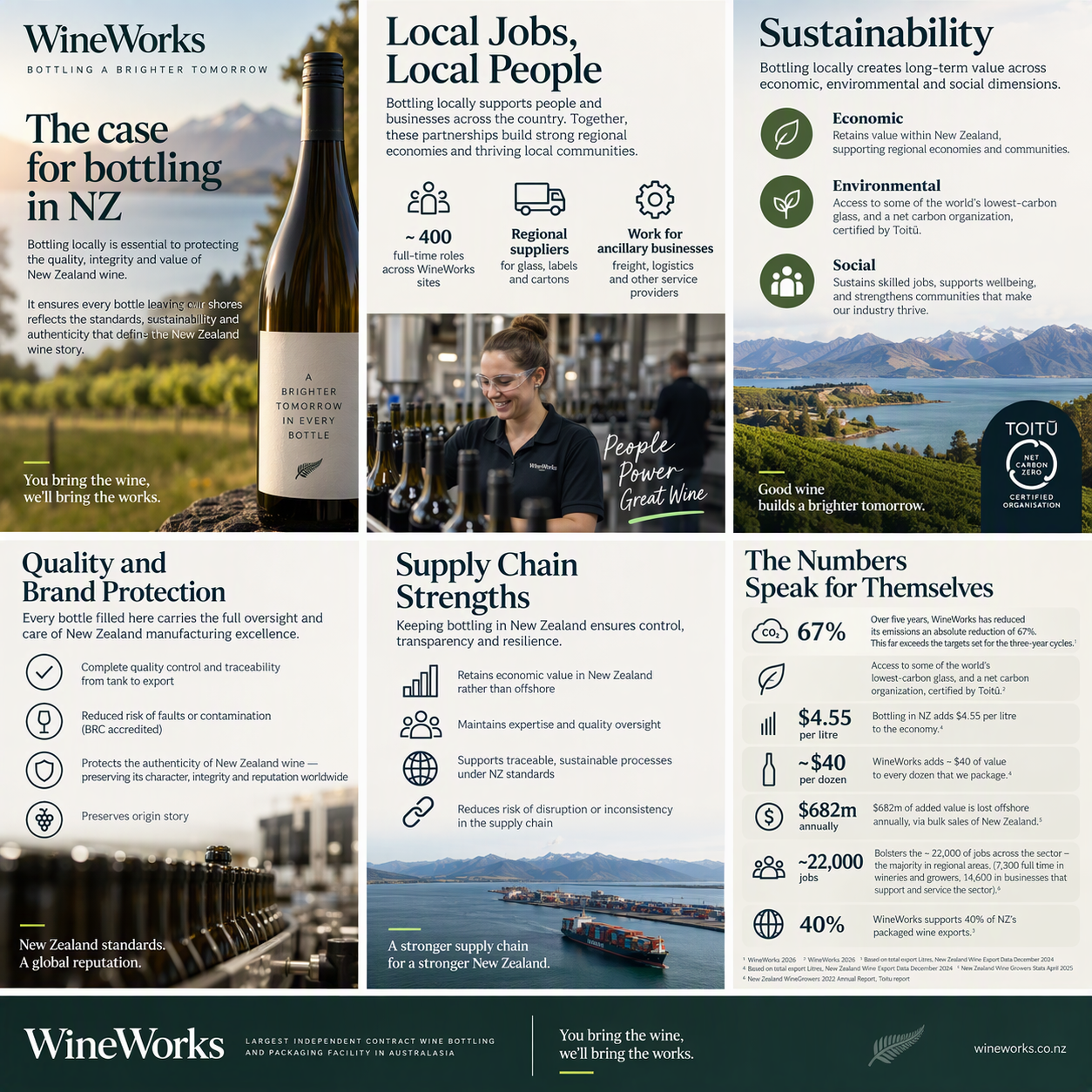
Premium wine requires premium value creation. The more value we retain in New Zealand, the stronger our industry becomes.
